Professor Barnabus and Friends:
A blog of my writing, my dog, my musings, my travels, my photography
and anything else that takes my fancy...
Please feel free to comment
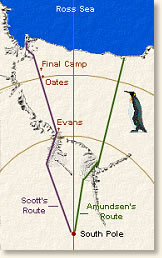
So, Edgar Evans was in fact the first person from Scott's crew to pass away on the expedition. He had cut his hand tending to a sleight and suffered from frostbite and exhaustion. Just before his death, he was described as turning mad - perhaps from the stress, illness or a fall. Here's an exerpt from Scott's diary:
"Saturday, February 17 - A very terrible day.
Evans looked a little better after a good sleep, and declared, as he always did,
that he was quite well. He started in his place on the traces, but half an hour
later worked his ski shoes adrift, and had to leave the sledge. The surface was
awful, the soft recently fallen snow clogging the ski and runners at every step,
the sledge groaning, the sky overcast, and the land hazy. We stopped after about
one hour, and Evans came up again, but very slowly. Half an hour later he
dropped out again on the same plea. He asked Bowers to lend him a piece of
string. I cautioned him to come on as quickly as he could, and he answered
cheerfully as I thought. We had to push on, and the remainder of us were forced
to pull very hard, sweating heavily. Abreast the Monument Rock we stopped, and
seeing Evans a long way astern, I camped for lunch. There was no alarm at first,
and we prepared tea and our own meal, consuming the latter. After lunch, and Evans still not appearing, we looked out, to see him still
afar off. By this time we were alarmed, and all four started back on ski. I was
first to reach the poor man and shocked at his appearance; he was on his knees
with clothing disarranged, hands uncovered and frostbitten, and a wild look in
his eyes. Asked what was the matter, he replied with a slow speech that he
didn't know, but thought he must have fainted. We got him on his feet, but after
two or three steps he sank down again. He showed every sign of complete
collapse. Wilson, Bowers, and I went back for the sledge, whilst Oates remained
with him. When we returned he was practically unconscious, and when we got him
into the tent quite comatose. He died quietly at 12.30 A.M. On discussing the
symptoms we think he began to get weaker just before we reached the Pole, and
that his downward path was accelerated first by the shock of his frostbitten
fingers, and later by falls during rough travelling on the glacier, further by
his loss of all confidence in himself. Wilson thinks it certain he must have
injured his brain by a fall.
It is a terrible thing to lose a companion in this way, but calm reflection
shows that there could not have been a better ending to the terrible anxieties
of the past week. Discussion of the situation at lunch yesterday shows us what a
desperate pass we were in with a sick man on our hands at such a distance from
home." Taken from: http://www.eyewitnesstohistory.com/scott.htm
The Terra Nova expedition had been gifted many things by wellwishers, including coal, cigars, plum puddings (?) and even a piano. In this piece I am describing a woman being shown around the ship before deperature (as they often were), and standing at the piano. I have used the piano as a metaphor for the declining mental state of Evans, who is with her at that time:
The Piano Man
“The wood will warp, sat out in the elements like this,” she thought, “the
moist conditions will wreck it.” It’ll look the same, of course, on the outside
but the workings will deform. The ice will work into its belly and fatten the
dampeners, and the frost will make the strings creep. The effect will be gradual of course, changing ever so slightly over time.
Getting almost imperceptibly flatter and flatter until one day it’ll sound so
horribly out of tune that you’ll wonder how you hadn’t picked up on it before.
You don’t notice these things though, not until the string is stretched so tight
that it’s likely to snap at any moment. She felt sorry for this piano. She took off a glove, ran her hand over the varnished mahogany, before
lifting up the fall and pressing a key. The note sounded out, as clear as a bell. A nearby pony looked up lazily from
its hay, regarding her with its listless eyes before returning to his meal. She looked up at him; a big oaf in a sailor outfit, smiling down at her. “You like the piano, miss?” he said. “Yes, very much so,” she answered, before gently shutting its lid.
Here's an article which I wrote for Uni about women in surfing. Enjoy:
Rise of the Beach Bunnies
“Surfing
and sex are inseparable,” says inertia.com surf editor Tetsuhiko Endo, but with
uneven contest prize money and sponsorship, do surfing and sexism come just as
intertwined.
Surfing has always been, and
probably always will be, a male dominated sport. Studies by the International
Surfing Association (ISA) estimate that worldwide there are between 17 to 23
million surfers, and out of those surfers, 15-20% are female. But according to
recent Global Industry Analyst reports, the worldwide surf market continues to
become more female and older, and considering that it is expected to reach $13.24 billion (£8.34 billion) by the year 2017, this is no
small movement. So, with these statistics in mind, why do the women’s tours
stand first to lose events due to lack of funds, why do women
surf the worst contest conditions and why do four of the world’s top seventeen women
surfers lack a major sponsor?
“The female side of the surf industry is about
selling clothes, that’s where the companies’ main income comes from,” says
Lucia Griggi, world-renowned surf photographer. And to sell the clothes, the
surfer needs to look good, hence the reason why many major sponsors are more
willing to give money to girls who fit the mould. “What that keeps reinforcing in women,” says
Queen of Teahupoo, Keala Kennelly to Endo on interia.com, “is that it is more
important to be beautiful, than it is to have talent or skill, or to be
accomplished.”
Keala surfing Jaws.
Women’s surfing does not
attract the sponsors or audience of men’s surfing, and even though the
Association of Surfing Professionals (ASP) set a rule that stating that any company who runs a
World Championship Tour (WCT) event must stage a women’s event as well, this
appears to be largely ignored. Louise Searle, editor of Surfgirl
magazine says that “the surf industry is in a bit of a mess at the moment [...]
which is why women who rip, like Paige [Hareb] are funding themselves. [The surf
companies] need to stay strong and remember their roots, the women’s tour
reflects this confusion and is leaving the girls frustrated, but the way
they’re marketed means [that] frock sales are more important than a thrilling
final in Hawaii.”
This would certainly explain
why surfers like Hareb have no World Tour sponsor, as the brands would prefer
to support younger, more commercial surfers such as Laura Enever or Sage
Erikson. Griggi, who travels on the tours with the professional surfers,
explains, “The companies don’t have [a large enough] budget to cover all girls,
[so] they choose the most marketable.” This means that there are two types of
riders on the tour, the few who are considered less attractive but have earned
a reputation as a good surfer, and the girls who are not as good at surfing,
but who look good in the clothes. Very few manage to straddle the line.
The girls are, of course,
aware of this and tailor themselves accordingly. Even Nike’s 2011 Leave a Message film, which by many was
viewed as a more credible girls surf movie showing “groundbreaking aerials and
long barrels”, still has a suspiciously large amount of footage of Monyca
Byrne-Wickey doing bottom turns in tinybikinis, not to mention Laura Enever surfing in a pair of fishnet
stockings. And this is by no means a recent occurrence, Wendy Botha, a four
times ASP world champion in the 1980s, posed naked for playboy. “It might be an indictment of surfing,” says the
surfline website, that Botha “is better known for her
spread in Playboy than for her incredible sporting achievements. That
fact says a lot about the pro surfing reportage of the past 20 years -- that
due to a male-dominated, and generally uninterested, surf media, some of
surfing's greatest champions have been ignored.”
Pro surfer Alana Blanchard
Professional female surfers
are aware that they are expected to walk the fine line between elite athlete
and poster girl. But they do so at the risk of sabotaging their credibility and
reputation, not to mention potentially compromising their surfing, as generally
a smaller physique means less power in turns. And the question needs to be
asked, are these surfers contributing to the objection by their compliance to
these ideals, forming a perpetual cycle of body image obsession. Unfortunately, according to the advertising,
it is not considered sexy to be athletic and strong.
The general, grass roots
image of surfing can be defined by mediums which are accessible to all. Of the
top 36 most viewed photos, tagged as ‘surf girl’ on magicseaweed.com, only eight
of those depict girls actually surfing. And one of those seems popular solely
for the fact that she is about to run over a pelican. And if you type the name
of Maya Gabeira, who is arguably the best all round, female, big wave rider in
the world, into a Google image search, there areno photos of her actually surfing until the
third page. Gabeira actually took a step further in the sex appeal stakes by
surfing naked for the ESPN Body Issue feature, which by its own admission
enables the readers to “gawk” at professional athletes, appearing alongside Steph Gilmore, Claire Bevilacqua, and
Men’s 11 times World Champion, Kelly Slater.
And the pros feel the
pressure, 2011 Red Bull Women’s World Champion Carissa Moore stated on her blog
that she often feels judged on her looks, stating that she has “trouble with
her weight” and can feel self-conscious performing “in front of thousands of
people in a bikini”. But as Searle remarked, “If I was Carissa, I would feel
self conscious too, but I can guarantee no one is watching her for looks, but
for her surfing skills.” However the question needs to be asked, why would one
of the sport’s top female competitors feel the need to conform to a physical
ideal. And could women conquer the balancing act of being feminine and
powerful, or in the eyes of the surfing community, are these mutually
exclusive.
But this is set to change as
more and more girls join the line up. “I see way more girls out there,” says
Jon, 37, a local Glamorgan coast surfer who has been surfing since childhood,
“it used to be a surprise to see a girl paddling out, but there’s definitely
more now. And they’re getting better and better.” A sentiment which seems to
divide local surfers, as Jamie, 39, says, “Having a girl in the line up changes
the mood, all the guys start to get all competitive and macho trying to impress
her. At the end of the day, I surf to get away from my missus.”
“I prefer to surf with
women,” says Porthcawl resident Jessica, 31, “the vibe is friendly and less
competitive. I feel that men judge the women first on their looks, and then
watch to see if we can actually stand up on a board.” Griggi illustrates, “Some
men have a little lack of respect [for women surfers], and will drop in on you
as they expect you not to make the wave [...], if you were a guy they would not
do this as much.” Many female surfers will be used to being judged when they
surf, especially in spots which are considered more challenging. The impromptu
audience feeling will probably be all too familiar, guys want to know if you
can handle yourself, and the best way to counteract this according to Griggi is
to “get a wave [and show] them you can surf, then they will leave you alone!”
However, regardless of the
stereotypes, the surf industry cannot help but take notice of the changing face
of women’s surfing. Surfing hardware is catching up to the standard of the
men’s as the demand for quality women’s wetsuit and wetsuit accessories
increases. Pro longboarder Kassia Meador has designed a fashion conscious
wetsuit range for Roxy, and the breadth of choice in women’s suits has
increased noticeably over the last few years. And the women themselves are
proving to the men that girls can surf just as hard as them, from Justine
Dupont’s October tow-in session at a
massive Aileen, during which she scored some of the biggest tubes ever ridden
by a woman in Europe, to Lakey Peterson’s technical air reverses.
And the effect is global, through
the Gaza Surf Retreat Project, girls are breaking down the gender barrier in
Palestine where the first female surf lifeguard has just been appointed, and in
Cuba, women bond through their love of surfing in a poverty stricken, isolated
country where trade embargoes mean that even the most basic surf equipment is
inaccessible.
Between us we are getting
bigger barrels, taking steeper drops, boosting higher airs and we are all
contributing to the changing the face of women’s surfing. “Most women and girls bring something more than beauty and a
sociological/psychological shift to the lineup,” says Surfermag’s Rob
Gilley, “they bring understanding. They bring grace.
They bring joy. To a pack of posturing men they bring the rarest commodity of
all: they bring smiles [...]. And if a girl happens to paddle out, I want you
to think long and hard before you snake the living daylights out of her.”
So, with girls charging
harder than ever before and pushing the boundaries further and further, women
all over the world are standing up to be counted, and it seems only a matter of
time before the phrase ‘You surf like a girl’ will be a compliment.
The Antarctic Expedition of 1910 New year, new module and this term we are doing historical fiction, centered specifically around Captain Scott's ill-fated journey to the South Pole. We are focusing on Edgar Evans (Taff), who was born in Rhosilli and was a member of the crew. He is on the right:
This is a fictionalised account of Evans walking down St Mary Street in 1910.
Off the train, across the street and there it is. The castle. I can see it
down the end of the road, and I know that if I went to the corner I could see
the clock tower, and the flags. And those animals with the glass eyes that make
it look like they’re staring at you. They look like I could poke them out with a
stick. I like the seal one the best, reminds me of my last trip down South, with
the Captain. If you stand still too long people walk right into you. Not like at home.
When it’s really busy, I press myself into a doorway out of the way of the men
and women and carriages and children, and just watch. The people don’t seem to
notice me at all, they’re all selling and buying, and hustling and bustling.
It’s hot today, even though the ladies try to make out they don’t feel it, with
their umbrellas and fans. I can feel it though, I lift up my hat and wipe the
sweat off with a hankie. There’s horses, loads of them, clattering up and down, carrying people and
goods. They don’t half stink. This summer afternoon doesn’t help, makes the
smell ten times worse. Someone wants to get into the door behind me so I have to
move, I wander further down the road over the uneven cobbles. There’s a newsboy
on the corner, selling newspapers, he’s shouting, “Read about it here ! Scott
voyages from Cardiff to the Antarctic”. Seeing it written like that makes me
nervous, I keep my head down and just keep walking. I can see a few pubs, up and down the street and down alleyways. I jingle the
change in my pocket. A man could get lost in a crowd like this. A sudden smell
of hops makes up my mind for me. I flip a coin to a beggar on my way through the
stained glass doors, and take a seat at the bar. D'Arcs Waxworks
So, it turns out that on St Mary Street there used to be a waxworks, which opened in April 1884 and was known as “Mons. D’Arc’s Grand
Waxwork Exhibition, Cosmoramic Views and Waxen Marionettes”. Here is the 1911 census slip for the address:
As you can (kind of) see, the widow D'Arc lived there with her married male servant, but his wife is not at the same address. Also listed are the amount of children she had, three of which died, and their places of birth. In the interests of historical fiction we were asked to write a creative piece which expands on their relationship and, and this is mine. It is again written from the point of view of Edgar Evans.
Wax on.
“This way, Mr Evans,” he said as he led me through to the back, “I can’t
believe it’s really you, our first real celebrity. I’ll show you our special
collection, yes I will. You can see with your own eyes.” I followed him through the penny slot arcade. Past the sleeping sailor with
his painted grin, ready to bounce into life, and the lines of ladies waiting to
dance behind the glass. They looked like broken dolls. The lamplight bounced off
the organ grinder’s monkey’s bead eyes as we passed. It made it look like he was
watching us. “Mr Evans. I can’t believe it, our very own explorer. Wait till I tell the
Lady about this! She’s not here now, she’s out on...business. She’ll be back
soon though, yes she will.” I asked him where we were going, the passage was so dark and cramped. I
couldn’t even stand up straight. “Just a little bit further, Mr Evans. It’s worth the wait, it really is.” He stopped in front of a wooden door and fumbled through a ring of keys.
There were three locks. “You have to be very quiet in here, Mr Evans. They’re sleeping,” he
whispered, “the Lady says that no one is allowed in here, but I’ll show you.
Just you though. It’s my best work. It can be our secret.” He opened the door. Inside, sat round the table were four figures; a man in his Sunday best who
looked to be about 60, and three young children. The table was laid for supper,
and there was a bowl of fresh fruit and a gas lamp on the table. “Ain’t they beautiful?” he hissed. They really were well made, they almost looked alive. I said that they were lovely, but I didn’t recognise them. I thought they
were supposed to be famous. “No, no, no,” he said, “These ain’t famous. These are hers. I made them
myself.” I said he did a good job. “You want to know the secret? How I made them look so good?” He smiled,
“well, you see the teeth, those are their teeth. And you see their hair, well
that’s their hair. And the fingernails? Those are theirs too. It took me a while
to find a way to do the eyes, but I did. And don’t they look grand. Look almost
as good as they did when they was alive.” I started to back towards the door. “No wait!” he gasped, “you’ll miss the best bit.” He then took a penny from
the tray and put in into a slot on the table. He stood back, triumphantly. I heard cogs clicking and whirring, and the sound of metal on metal.
Then some music started playing, something that little’uns would listen to. It
seemed to come from everywhere. The lamp on the table began to turn, throwing
shapes onto the wall and across the figures. And then with a clank, they too
began to move, lifting up their cups and nodding their heads like they were
talking. “Ain’t they magnificent,” he breathed. I felt the door behind me, backed through it, thanked him, and then
turned and ran.
 "Saturday, February 17 - A very terrible day.
Evans looked a little better after a good sleep, and declared, as he always did,
that he was quite well. He started in his place on the traces, but half an hour
later worked his ski shoes adrift, and had to leave the sledge. The surface was
awful, the soft recently fallen snow clogging the ski and runners at every step,
the sledge groaning, the sky overcast, and the land hazy. We stopped after about
one hour, and Evans came up again, but very slowly.
"Saturday, February 17 - A very terrible day.
Evans looked a little better after a good sleep, and declared, as he always did,
that he was quite well. He started in his place on the traces, but half an hour
later worked his ski shoes adrift, and had to leave the sledge. The surface was
awful, the soft recently fallen snow clogging the ski and runners at every step,
the sledge groaning, the sky overcast, and the land hazy. We stopped after about
one hour, and Evans came up again, but very slowly.  It is a terrible thing to lose a companion in this way, but calm reflection
shows that there could not have been a better ending to the terrible anxieties
of the past week. Discussion of the situation at lunch yesterday shows us what a
desperate pass we were in with a sick man on our hands at such a distance from
home."
It is a terrible thing to lose a companion in this way, but calm reflection
shows that there could not have been a better ending to the terrible anxieties
of the past week. Discussion of the situation at lunch yesterday shows us what a
desperate pass we were in with a sick man on our hands at such a distance from
home." 


