Showing posts with label cardiff. Show all posts

Monday, 16 December 2013

Cardiff Alms


The Monico 

We are gathered here today in remembrance of a lady dear to all our hearts, who has now been demolished and turned into luxury flats.  

I remember when it happened. After years of darkness she sat blinking in the sun, her back wall ripped out exposing row upon row of faded red seats. Through the lesion I could see her sleepy projector window clouded with glaucoma, and her set of centre steps which now just led to nothing.  

Unfortunately, it wasn’t done with any kind of decorum. It was as if someone had bent her over, lifted up her brown and yellow skirt and showed her big granny knickers to the world.  

And that was that, the heavy velvet curtains drawn on the days of Saturday cinema, the screechy Wurlitzer organ and the parade of birthday children. The credits had rolled on the excitement of seeing the stern-faced, Mr Monico in the foyer and the nomination of who was going to ring up the answer machine to get the timetable. 

Her carpets were sticky with generations of ‘not to be sold separately’ cans of coke, kernel-heavy popcorn and overpriced Revels. “Keep the floor neat beneath your feet”, she’d say, “Refreshments are available in the lobby,” and then serenade us with the ‘Pearl and Dean’ theme tune. 

She was a place of playdates, first dates and Beauty and the Beast. Not to mention burgeoning romances and first-time teenage fumblings. I distinctly remember a man smoking in there once, big puffs billowing up through the projector beam. My mum was too polite to say anything. 

Mr Monico came through my brother’s till in Tesco a few years after, and he was surprised to learn that his name wasn’t Mr Monico at all, it was in fact, Mr Bull. He looked genuinely upset when he later informed me of this.  

And so, with a heavy heart, we say goodbye to this Disney sympathiser, Titanic trader and Star Wars supplier. 

We’ll miss you. 

 
The Cabin

Roald Dahl referred to the sweet shop in Boy as ‘the very centre of our lives.  To us, it was what a bar is to a drunk or a church is to a Bishop.’ And I would hasten to agree.  

What The Cabin brought us, with her little round windows and moss-green roof tiles, was a haven. She was the communal grandmother, the saccharine reward to keep me still in church that became a Sunday ritual. 

With my pocket money burning a hole through my ladybird purse, I would count out penny sweets into the paper bag, pondering over my selection. Kola Kubes, Millions, Sherbet Lemons, Milk Bottles, Flying Saucers, Lemon Bonbons; all were scrutinised and mulled over. Not just anyone got in.

Once, the man behind the counter informed me, to my horror, that I was one penny short. He winked at me and told me not to tell anyone, handing over the corrupted bag with its nefarious stash. I reached up and took it, awe-struck. I couldn’t believe he’d put his neck on the line just for me. There and then I made a solemn oath that to my dying day, I would not reveal this treacherous debt. As soon as I got home, I hid the incriminating sweet bag in the back of Noel, my zip up monkey, and took from it furtively.  

She’s a chiropractic clinic now, the Cabin. They tore out her wooden shelves, shelves which used to hold jar upon jar of tooth-rotting bribes and sticky enticers, to make room for treatment couches. They lino’d over the wood and white-washed her walls. Now people go there to get their backs cracked and joints adjusted.  

It just doesn’t seem as fun.

May she rest in peace.


The Bandstand

A friend to the people of Cardiff and to Bon Jovi, the Bandstand was a man to be trusted and depended upon. He the meeting place for countless people over numerous generations. I myself used to wait for friends with him, in the days before mobile phones, when we just made solid plans. I also spent most of an afternoon with him once, queueing to meet the Super Furry Animals in Virgin Megastore. There was an awkward picture of me in the Echo the next day, clutching my newly signed copy of ‘Rings Around the World’ and looking like, as I did for about a year, the oldest one from Hanson.  

“I’ll see you there at eleven”, we’d say, carefully timing our phone call to try to avoid the embarrassment of having to speak to one of our friends’ parents. I’d only had the five minute window of when my mum chucked my brother off the dial-up so I could use the phone. “You should get outside more”, she’d tell him, brushing back her perm and adjusting her massive glasses. So, bang on eleven we’d turn up in our hippy skirts and Gwen Stefani bindis, skirting the Goths which congregated on him to smoke.  


He supplied a familiar facade, a destination to aim for. He was reliable and stalwart, a permanent fixture. And then one day, he was gone. It happened so fast it was over before I’d even acknowledged it.  

They paved over his uprooted foundations and twisted his ribs up through the concrete to make bike racks.  

 People walk over his grave every day and have no idea he was ever there.  


Rhiwbeina Infants

I am happy to see so many of her friends here today, and I’m sure many of you will remember her with the same fondness and affection as I do.  

She had been my first teacher. She had stuck star stickers on my recorder and taught me how to write my name. She was there the time I forgot my vest and had to do PE with my dress tucked into my knickers, and when Sophie peed herself during assembly and I had to keep shuffling further and further back to escape the spread.  

She had sympathised with me when I was sick all over her parquet floor (in my black and white stripy jumper) and the time I was caught drawing pencil stars on the desk (wearing the cursed flowery dress which I refused to wear ever again). I was made to wipe them off with the entire class standing around the table watching, my face hot and red.  

“You missed a bit,” said Chloe, which was ludicrous, as she had drawn just as many stars as me. In fact, she had drawn the first.

It was that moment that I realised that there was no justice in the world.  

It was a sad time, the night she burnt down. I was there myself, watching her impromptu pyre from the fence, bundled up in my snowflake dressing gown and wellies. I remember feeling the heat on my face and the cold autumn air on my back, like ice cream and warm chocolate sauce.  

We stood in silence, the whole street, the dead air punctured by a steady crackle and the occasional muffled crunch. Her immolation was hard to watch. I thought of all the ‘mummy and daddy’ crayon drawings and the painted hand prints that were now reduced to just spiralling embers.  

But she lives on through us. I have many fond memories of her, which I’m sure you all do too. She was a teacher to us all.  


Zeus

It is with great sadness that I stand in front of you to remember the life of Zeus. He was a brother, a father and a friend, not to mention a matchmaker and a pretty damn good dancer. 

For me, he bridged the gap between childhood and adolescence, a neon lantern in the dark no-man’s land of the first few years of high school. Through his under-sixteen nights he taught me about boys, about wearing heels and the importance of keeping your head up during a foam party.  

We’d queue round the block for an hour or so, girls on one side, boys on the other. The doormen would check our pockets for cigarettes and our bags for booze. I never tried to sneak anything in, I was far too much of a goody two shoes. One time, the woman on the door gave me an odd look when she reached into the pockets of my denim jacket and found them packed to the brim with sanitary towels. My mum said I only needed to take one, two at the most, but I always was paranoid about stuff like that.  

Once inside, we’d totter up the stairs in our super cool wedged sandals and pedal pushers and immediately cluster in a corner. We couldn’t believe what some of the girls were wearing.  

After scoping it out a bit, and getting the obligatory group photo taken (that’s three pounds each, you can pick it up on the way out), we’d make our way over to the dance floor. He’d always play the 90s favourite, ‘Livin’ la Vida Loca’, which was always, always followed up with ‘Mambo Number Five’. We’d always dance in a circle, not daring to put our handbags down after our parent’s stern warnings: there could be kids from Cantonian here.  

Although someone now stands where he once stood, he’ll always be special to us. He was the platform for our first foray into adulthood, showed us what it was going to be like from there on in, taught us what it was to be big.

And for that, I thank him.

Thursday, 17 October 2013

The Monico


After years of darkness is seemed to sit blinking in the light, its back wall ripped out, exposing row up row of faded seats and the sleepy projector window.  It wasn’t done with any kind of decorum, it was as if someone had bent it over, lifted it up its brown and yellow skirt and showed its big granny knickers to the world.

And that was that, the heavy red curtains drawn on the days of Saturday cinema, with the screechy Wurlitzer organ and the parade of birthday children, and the excitement of seeing the stern-faced Mr Monico in the foyer. It was a place of playdates, first dates and Beauty and the Beast.

I used to think that the words ‘Monico’ and ‘Cinema’ were synonymous with each other, and that the giant pot holes in the car park added to the charm. Its carpets were sticky with generations of ‘not to be sold separately’ cans of coke and overpriced Revels. I distinctly remember a man smoking in there once, big puffs billowing up through the projector beam.

When my brother served Mr Monico in Tesco a few years later, he was surprised to learn that his name wasn’t Mr Monico at all, it was in fact Mr Bull. He looked genuinely upset when he later informed me of this.

We had both been duped.

Saturday, 4 May 2013

The Mayfly - Assessment Short Story.


Long time no see!

So, assessment time is upon is again and I chose to write a steampunk, alternate history love story.

In class we looked at China Mieville's novel The City and the City in which the city in question is split into two cities occupying the same space but not acknowledging eachother. It's a bit hard to explain, here's the
wiki.

So, I chose to write about a city which is divided not politically but temporally, meaning that the characters experience time at different speeds with each group ignorant of those who move faster than them. In fact, one group experiences time so slowly, that they only live for one of our days. SImilar to the fact that we know trees get bigger but we never see them actually grow, because it's too slow for us to acknowledge. Hmm, maybe you should just read it, let me know what you think:
 
The Mayfly

She was falling to the ground, her hair out in front of her like ribbons, her eyes locked on mine. I had touched her and she could see me.

She was looking right at me.

I should have moved, hidden, but her gaze held me petrified.  I watched her tumble, I stood by and saw her skirt begin to billow out in front of her. They moved around her, the others, the rumbling rocks. No one had noticed her yet.

But I had.

This one that I had been watching my whole life, who my Elder and his Elder had watched before me, and theirs before that. She was ours, our girl, our reason. My life revolved around her, around this moment. I saw the sign and I had acted, I had reached out and touched her.

 And now she could see me.

She had packed her bags, was carrying her luggage. She had taken her pictures off the wall and her trinkets off the shelf, she wasn’t planning on returning. Before my Elder passed, he told me that he had seen her book her ticket, that she was going to leave and we’d have to go with her.

We were bound to her.

I had watched her leave her house and followed her here, to this place which is full of them, the Dwellers. Their different shapes and sizes, colours and shadows. I looked on, as I do every day, as she took one ponderous step after another, surrounded by those who are like her yet not quite the same.  Their deliberate movements, their thundering speech. They moved around her but did not see what I saw.

She shone among them.

I’ve seen her grow. Spent an age watching her brush her hair or tie her laces. I know all her secrets, the Automon Spider she carries with her that’s been broken for years yet can’t bear to throw away, her grandmother’s engagement ring that she lost and didn’t tell anyone about. I know where it is of course, it had rolled between the floorboards and fell through a crack. It sits there still. She had looked for it for hours.

My Elder told me about the time she had fallen from a wheeler and broken her leg, she had screws in there now. His Elder had seen her trip when she was smaller, bite her lip and draw blood. If you looked closely you could still see the scar there now. She hated it, but for me it linked me to my Elder-Line, they had witnessed the event and I could still see the evidence. It tied me to them.

I knew every line on her face, every mark, scar and freckle. I knew her routines, that she didn’t like strawberries, that she secretly wished she could be a little taller, and that one time she had cut herself just to see what it would feel like. In her almanacs I had read about the first boy she had loved, the one she kept a picture of in her diary. He didn’t know, she never told him.

He didn’t deserve her.

Others had begun to notice she was falling, I saw their eyes pivot toward her. The girl all in red, a battered suitcase in each hand, tipping back on her heels. A lamplighter over near the clacker stand had seen her, he made as if to go to her and break her fall. He wouldn’t make it in time though. Neither would the woman with the cages of bronze birds, little gems and beads lining their wings, clicking and whirring, their tiny eyes lit green. Souls made from cogs and springs.

And through all of this she watched me, her eyes crinkled in confusion. Or in fear.

I looked down at her tickets, the ones I had taken from her hand, embossed and perforated and gold around the edges. There were words on them, a language we didn’t understand. I had panicked, I had had to stop her getting on that airship, it wasn’t the way for her. I had felt it, the premonition, the foreboding feeling, I saw a flash and that had confirmed it.  I was taught to rely on my instincts and it had been my time to act.

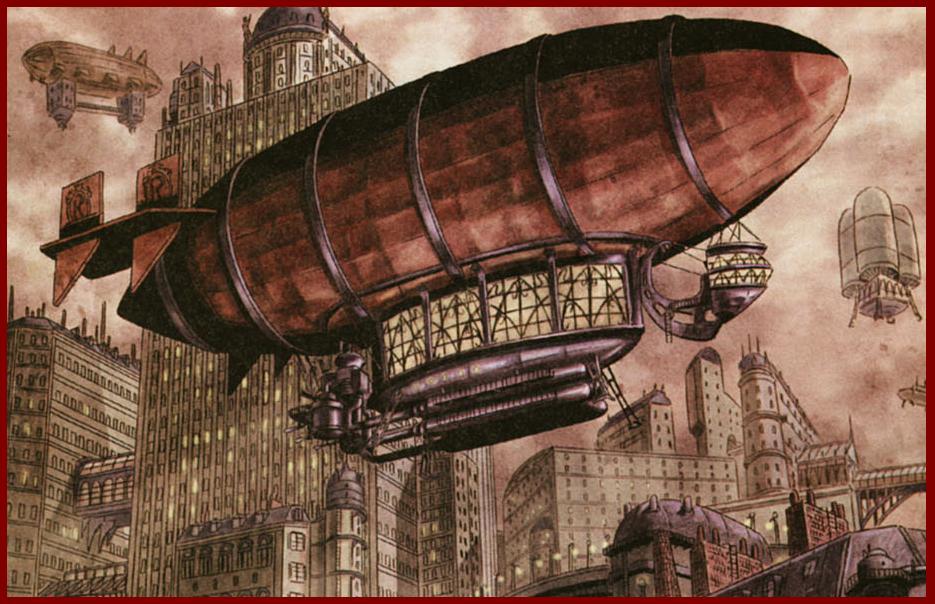
I looked up at the airship, creaking on its ropes, the bunting tethered to the ground undulated in the breeze. There was a band on the boarding platform, their brass buttons shone in the noon sun. Above, the propellers cut lazy circles from the heavy summer air and the steering bellows wheezed laboriously. The light glinted off the domed observation windows and mottled on the side sails, it was hard to look right at it.

Everything seemed so perfect.

There were Dwellers up there, hundreds of them, hanging their heads over the railing and waving, smiling and laughing, shouting and singing. I watched the streamers spiral, the confetti rain down around the Dweller crowd. I could have plucked it right out of the air if I had wanted to, but instead I let it fall to my feet, to become muddied in the cobbled puddles.
 
When I looked at her again, she was nearing horizontal, her back straight and her body stiff. The woman with the birds had opened her mouth and was booming, the lamplighter had dropped his torch and was midflight, other Dwellers were turning to look. A sea of moving faces under feathers and hats.

 Yet still she fell.

Then, her eyes left mine and began to roll up into her head.  Through her eyelashes I could see the white crescents, her blinking drummed a rhythm. I saw a tear scribe a smooth arc down her cheek, one and then another. She stayed like this until she hit the floor. They were almost to her, to try and catch her as she fell, to cushion the impact.

But the only one who could have caught her was me.

Her head cracked against the cobbles with a shattering blow, rebounding twice.  The thud was deafening, her neck snapped back and forth, her ringlets uncoiling. A suitcase burst open, her belongings airborne in a leaden parabola. Out tumbled the Spider, its internal cogs and defunct springs flying, catching the sun as it smashed into the ground, it’s visceral mechanics skittering away.

They were beginning to crowd around her, I needed to move. I slipped in between them as they circled her, leaned in over her, concern on their faces. Through their legs I could see her body lift and contort, her jaw bulging as her teeth churned against each other, her hands balled into fists. I saw her tendons tightening in her neck and forearms, the muscles contracting and twisting. The Dwellers around her looked at each other, unsure of what to do.

She hadn’t done this before, it would have been recorded, written down in her almanacs. I had studied them over and over again and there was nothing like that in there. I knew everything about her yet never expected anything like this.

There must have been a reason, or is all this for nothing, a leap of faith into a bottomless pit. I had felt so sure that it had been the time. I glanced wildly around me.

It has to be something around here, somewhere.

I looked up and I saw it, there was smoke coming from the airship. Only the smallest bit at the moment, not enough for them to realise. Wispy spirals too slight to notice, reaching tendrils that gradually bloomed from white to grey to black. A glow permeated the fabric, it was alight inside. There was no explosion, or warning, just a slow creep of illumination, a lumbering blaze, the shuffling death.

I stood transfixed. A butterfly ambled lethargically past me, I could feel the whirring vibrations of its metal wings as it passed.

This was it.

I looked at her again. She lay still, someone was putting a coat under her head. Her eyes were open, but dull and glazed over, staring straight up. The bird woman was holding her hand, her other lay on her forehead. A man in a tall hat had pulled over a talker, the boy looked over their shoulders in concern as the man shouted into the speaking tube, his other finger jammed into his free ear. Another man had begun to take off his jacket.

The smoke had begun to turn black, spiralling skyward. Before long the plumes were haemorrhaging through the breach, the ribs of the ships structure were already beginning to show.  The flames were spreading, the internal luminosity growing in size and intensity. As I watched, a lone piece of ash pirouetted through my gaze, I let it come to rest on my upturned palm, it was still alight.

They began to scream.


From my vantage point I could see it all. He who attended her, the Sleeper in red. I had been watching him from the beginning, from my very birth. From the moment I felt the sliding warmth engender me, I became it and it became me.

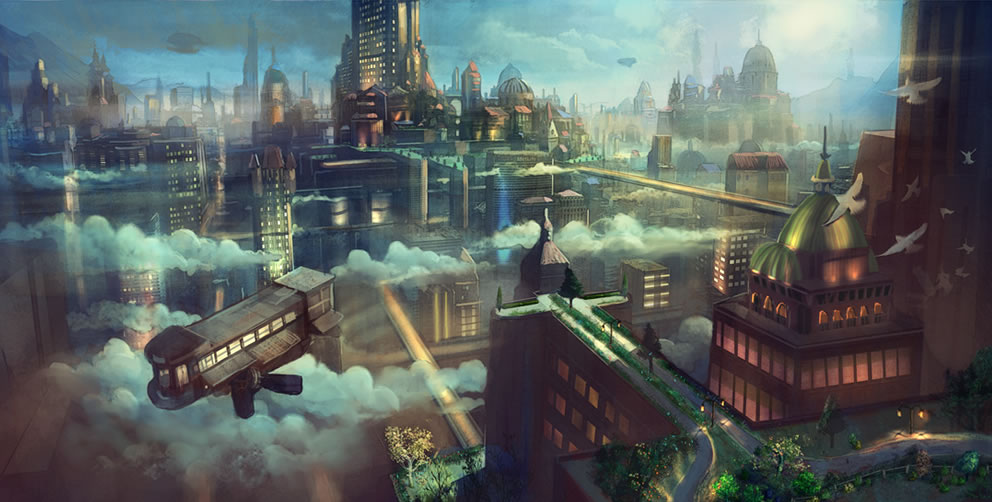
As a child I had followed him, from that other part of town. The part with the spirals and bridges, and the towers that sit so close to one another and the lights that live inside, behind the coloured glass. They are like me, but different. They glow through metal, harnessed, enslaved, ready to be used again and again, trapped by those who live through the darkness, when the Mother-Sun has gone, the ones who live forever, through countless cycles.

He was down there in the crowd, among them, surrounded by them, the Sleepers. He was going to follow her onto the ship, the one which was packed full of them. They put so much faith in these things, these objects and technologies. They didn’t see what I see, the near misses, the imperceptible wear and tear. They lived too slow for that.
 

I knew it was going to happen, of course, I had watched the air change and the gas leak. It was lighter than the air around it, I watched it escape and then float away, dissipating into the blue. It was so obvious, to me. I had been watching the cogs and pulleys and cams and pistons, I had seen them ever so slightly skip a beat, or change rhythm, move a little off course, misfire.

They never notice, of course.

I had seen the charge begin to build up, the minute spark which would trigger all this. I knew there and then that the time to act was upon me. I had looked over the side, seen him next to her, they were going to climb the tower, pass the band and then board. He needed to be saved and I was ready to do it.

I had watched him until he slowly rotated his head in my direction, before gathering myself and sending out a charge. Nothing too obvious, just a flash, a reflection perhaps, or a spark. A message.

He had seen.

I had floated down for a closer look, to make sure. This close, I could see the panic in his eyes and etched across his face. I watched him begin to circle her, to search her for a way to intercept, a way to change her life-course without her noticing.

By the time I had drifted back up to the ship, the leak had doubled in intensity. I could see the pressure of it as it forced its way through the puncture holes. I could see the air moving with the rising temperature, shimmering ripples of combustion. I could feel its energy, the static in the air, I watched the dancing phosphoresce as it converged across the fabric.

I looked down at him, he was reaching tentatively toward her. I sailed down to them. His hand moving toward hers, carefully as not to touch her unnecessarily. He was going to take the paper tickets which she held pinched between her thumb and forefinger, her others curled around the handle of a case. I watched him for a while as his fingers edged closer and closer towards hers, I was envious of their proximity.

They were almost touching.

I wanted to be part of it, I wanted to feel him like he felt her.

He who made me shine.

I wanted to know what they’d have when they made contact, when he reached to her and they touched. I wanted to share in it, take away its intimacy.

And so, when he was just closing in on her, ready to swipe the tickets out of her hand, I held out my hand and lightly placed it over theirs.

The surge of energy pulsed through me, it hammered at the inside of my chest and jolted down my back. I retreated instantly through the static crackle, electricity flickering on my fingertips

I had bridged the gap.

 I had completed the circuit.


I woke up to the sounds of running footsteps. I didn’t understand where I was. My head was pounding, a dull, thudding pain. I could hear voices, screaming. There was something falling from the sky, bits of black paper, a cloud of dust perhaps, I could feel it settling on my face. There was someone holding my hand, a woman. I moved my eyes to look at her, she didn’t see me. She was gazing up at something.

I squeezed her hand, the woman looked down at me.

“She’s awake. You’re ok, just had a fall. Do you think you can walk, we have to move.” There was an edge to her voice.

I nodded, I felt sick. She pulled on my arm and helped me to my feet, slipped her arm around me and under my shoulder.

I could hear the horns of the emergency wheelers, there was something happening.  

“What’s -“

“Don’t try to speak right now, we need to move out of the square,” she began to shuffle me forwards, my head was spinning.

“Why?”

“There’s been an accident.”

I remembered that I had been going to the airship, today was the day that I was leaving for the Islands.  And there was something else...

There were people running everywhere, they bumped into us as they tried to get in or out of the square. I didn’t understand what was happening. My head was still aching, my vision blurry.

There were people crying, shouting. There was a tinge to the air, a taste. I could feel heat pressing through my summer dress and onto my back.

Burning.

I stopped and swung around.  There, suspended from what was once the boarding tower, hung the twisted girders of the airship, like the skeletal remains of some giant insect swathed in fire. I gasped, the scene was like something from the Centre War. Black smoke billowed out of the wreck, diluting the midday sun. There was death in the air.

The sun.

 I remembered. I had seen something, someone, a man.

“Oh Gods, look,” she held her hand out to point, I followed her gaze. There were people jumping from the remains of the ship, a last ditch attempt to escape the engulfing inferno. Some of them were on fire.

A man, a man who had seen me as I fell. A man who was different. A man who moved so fast.

“We have to get out of here,” she said and began pulling at my arm. But I wanted to stay, I wanted to help. I felt...connected to it somehow.

Two wheelermen pushed past me holding a stretcher. The indistinguishable figure on it held its arms up rigidly, the burns so tight around the elbows that they would not bend, charred skin hanging like second sleeves. It was one of the lucky ones, the square was strewn with bodies, pulled out of the wreckage, already dead or deemed without hope, left to go quietly. The wretched meek, scratching pathetically on Death’s door.  

 Yes. I had seen a man, I didn’t recognise him but I knew him. He had been there when I had fainted. I looked for him in the crowd, I’d never find him now.

The airship was now completely in flames, the wood and fabric providing the perfect fuel. The air was filled with ash, it was hard to breathe, many had tied scarves around their faces. The smell of charcoal and burning flesh hung heavy in the air. I tried not to think about it.

 “Come on,” I said to the woman as I tore a strip off my dress and tying it around my mouth. With a sigh she did the same. We pushed further into the square, the heat was almost unbearable even here. We started circling the bodies, checking for signs of life. There weren’t many, most of them had been burnt beyond recognition, their clothes singed and black. This one must have been a child, the rigour mortis bending it into the foetal position it had so recently come from. And here a woman, she still had patches of long blonde hair. I went to move on.
 

Wait. Movement. She was moving.

I bent down, put my cheek near her scorched face, no breath. She moved again, it was under her clothes, I unknotted the fabric at the front of her dress and out shot a tiny hand, clean and perfect.

There was a heaving screech, I looked up. The tower was beginning to collapse. I pulled out the child and ran.
                                                           x
 

Monday, 4 March 2013

Counterfactual History

This piece is based on counter-factual history, which is described by some lovely person at Wikipedia as this:


'Counterfactual history, also sometimes referred to as virtual history, is a form of historiography that attempts to answer "what if" questions known as counterfactuals. It seeks to explore history and historical incidents by means of extrapolating a timeline in which certain key historical events did not happen or had an outcome which was different from that which did in fact occur. It has produced a book genre which is variously called alternative history, speculative history, counterfactual history, or hypothetical history.'
 
It is seen in novels such as Resistance by Owen Sheers, or Fatherland by Robert Harris. Both of these texts are focused around the idea of the Allies losing the Second World War, and the Nazis invading Britain.
Fatherland is on my to-read pile, but  I really enjoyed Resistance.

So, reluctantly sticking with the 'Scott of the Antarctic' theme (my lecturer seems to love it), here's my counter-factual take on the disembarking of the Terra Nova.


We built this city on rock and coal.


Evans looked over the edge of the observation platform, they were almost ready to go. The pile of the supplies on the tethering tower had dwindled, been successfully stowed somewhere aboard ship. The ponies had been difficult. As everyone knows, ponies are notoriously malfooted when it comes to ladders. Even the specialised, extra wide rung one which had been gifted to them. They were settled now though, he could hear them beneath deck, contented snuffling and nosing their hay. He wondered if ponies had a fear of heights. He hoped not.

From up here the crowd just looked like a sea of hats, all fancy and colourful with feathers and flowers. The noon sun prevented anyone from looking up for too long, he liked it that way. They’d shield their eyes with one hand, and wave with the other. He didn’t wave back though. He could see Scott down there too, checking the ropes, making the final adjustments, looking over the hydrogen tanks.

He reached out over the railing and hooked his finger over a string of bunting and pulled it back. When released it made a satisfying twanging sound. A seagull at the other end of the rope squawked as it wobbled to a standstill. Evans looked at the seagull, the seagull looked at him. Then, with the slight narrowing of his eyes and a flourish of the tail, the seagull pooped. Evans watched it sail down and then splash onto a lady’s hat. She didn’t even notice.

The crowd roared beneath him and the band struck up. He saw Scott begin to climb the ladder. Evans slipped on his flying goggles and the engine spluttered into life. He cracked a smile and waved disconsolately as the propellers began to turn.


Sunday, 3 February 2013

The Terra Nova Expedition.

The Antarctic Expedition of 1910

New year, new module and this term we are doing historical fiction, centered specifically around Captain Scott's ill-fated journey to the South Pole. We are focusing on Edgar Evans (Taff), who was born in Rhosilli and was a member of the crew. He is on the right:


This is a fictionalised account of Evans walking down St Mary Street in 1910.

Off the train, across the street and there it is. The castle. I can see it down the end of the road, and I know that if I went to the corner I could see the clock tower, and the flags. And those animals with the glass eyes that make it look like they’re staring at you. They look like I could poke them out with a stick. I like the seal one the best, reminds me of my last trip down South, with the Captain.

If you stand still too long people walk right into you. Not like at home. When it’s really busy, I press myself into a doorway out of the way of the men and women and carriages and children, and just watch. The people don’t seem to notice me at all, they’re all selling and buying, and hustling and bustling. It’s hot today, even though the ladies try to make out they don’t feel it, with their umbrellas and fans. I can feel it though, I lift up my hat and wipe the sweat off with a hankie.

There’s horses, loads of them, clattering up and down, carrying people and goods. They don’t half stink. This summer afternoon doesn’t help, makes the smell ten times worse. Someone wants to get into the door behind me so I have to move, I wander further down the road over the uneven cobbles. There’s a newsboy on the corner, selling newspapers, he’s shouting, “Read about it here ! Scott voyages from Cardiff to the Antarctic”. Seeing it written like that makes me nervous, I keep my head down and just keep walking.

I can see a few pubs, up and down the street and down alleyways. I jingle the change in my pocket. A man could get lost in a crowd like this. A sudden smell of hops makes up my mind for me. I flip a coin to a beggar on my way through the stained glass doors, and take a seat at the bar.


D'Arcs Waxworks

So, it turns out that on St Mary Street there used to be a waxworks, which opened in April 1884 and was known as “Mons. D’Arc’s Grand Waxwork Exhibition, Cosmoramic Views and Waxen Marionettes”. Here is the 1911 census slip for the address:


As you can (kind of) see, the widow D'Arc lived there with her married male servant, but his wife is not at the same address. Also listed are the amount of children she had, three of which died, and their places of birth. In the interests of historical fiction we were asked to write a creative piece which expands on their relationship and, and this is mine. It is again written from the point of view of Edgar Evans.

Wax on.

“This way, Mr Evans,” he said as he led me through to the back, “I can’t believe it’s really you, our first real celebrity. I’ll show you our special collection, yes I will. You can see with your own eyes.”

I followed him through the penny slot arcade. Past the sleeping sailor with his painted grin, ready to bounce into life, and the lines of ladies waiting to dance behind the glass. They looked like broken dolls. The lamplight bounced off the organ grinder’s monkey’s bead eyes as we passed. It made it look like he was watching us.

“Mr Evans. I can’t believe it, our very own explorer. Wait till I tell the Lady about this! She’s not here now, she’s out on...business. She’ll be back soon though, yes she will.”

I asked him where we were going, the passage was so dark and cramped. I couldn’t even stand up straight.

“Just a little bit further, Mr Evans. It’s worth the wait, it really is.”

He stopped in front of a wooden door and fumbled through a ring of keys. There were three locks.

“You have to be very quiet in here, Mr Evans. They’re sleeping,” he whispered, “the Lady says that no one is allowed in here, but I’ll show you. Just you though. It’s my best work. It can be our secret.”

He opened the door.

Inside, sat round the table were four figures; a man in his Sunday best who looked to be about 60, and three young children. The table was laid for supper, and there was a bowl of fresh fruit and a gas lamp on the table.

“Ain’t they beautiful?” he hissed.

They really were well made, they almost looked alive.

I said that they were lovely, but I didn’t recognise them. I thought they were supposed to be famous.

“No, no, no,” he said, “These ain’t famous. These are hers. I made them myself.”

I said he did a good job.

“You want to know the secret? How I made them look so good?” He smiled, “well, you see the teeth, those are their teeth. And you see their hair, well that’s their hair. And the fingernails? Those are theirs too. It took me a while to find a way to do the eyes, but I did. And don’t they look grand. Look almost as good as they did when they was alive.”

I started to back towards the door.

“No wait!” he gasped, “you’ll miss the best bit.” He then took a penny from the tray and put in into a slot on the table. He stood back, triumphantly.

I heard cogs clicking and whirring, and the sound of metal on metal. Then some music started playing, something that little’uns would listen to. It seemed to come from everywhere. The lamp on the table began to turn, throwing shapes onto the wall and across the figures. And then with a clank, they too began to move, lifting up their cups and nodding their heads like they were talking.

“Ain’t they magnificent,” he breathed.

I felt the door behind me, backed through it, thanked him, and then turned and ran.

Tuesday, 24 April 2012

Prof. Barnabus von Chocolate - video debut.

Well guys, look at what we have achieved:


He's like a finely tuned obedience machine! Check him out!

And, when he's in the trees, copse, grove, thicket or woody hollow, he even comes out intermittently to check if I'm still there. Awesome.

The only problem is he runs in one bit and then reappears somewhere completely different. A few times, I've been stood there waiting for him and he comes bounding out of the bushes in a completely different area. I think he gets onto a scent trail and goes nuts.


A cyclist was laughing at me as Prof. Barnabus had run through the fence to go for a drink/quick dip in the river, and I was calling and calling him and then I heard him bark, and he was right behind me. He'd found a different hole in the fence to come back through. Tricksy hobbit.

He looks so stoked when he's running around hunting for squirrels, total blissed out expression on his face. Amazing.

x

Friday, 13 April 2012

Operation Australia

Today is Friday (day off!) and on Sunday, my Mum and Mike left for a month long trip to Australia. Which leaves me and the Professor alone - for a whole month...

If I'm going to be honest, the operation did not start well. In an effort to alleviate the stress, I moved my laptop and all my books downstairs so Barnabus has some company. I have now completely taken over the kitchen table with all my texts, save for the space left for the massive chocolate egg which I have to 'share with the others'. At this point, Barney had not come out of his bed.

So, Sunday night and first walk time. I had to reach into his dog-cave, as he pressed himself up against the back wall, and attach his harness while he was in there. Once attached, he came out willingly, but eyed my over his shoulder the entire walk as if to say 'she is STILL following me.'


I did try and take him out into the sunshine as I was making poetry notes in the garden, but as you can see below, Barney was not in the mood for socialising.


Not in the mood at all.

The week seemed to continue this way, until on Tuesday night we had a break through. I went to his bed (where he has taken up permanent residence), and showed him his harness and he jumped right out! Amazing!

So, yesterday I think - 'this is it, he is finally used to me' and after a few experimental, but successful, 'Barney come here!''s I decided to let him off the lead. It initially went well; he ran off, I called him, he came back, I gave him a treat, he ran off, I called him etc but then, he ran off.

Like, properly ran off until he was just a brown blur with a little white bum bouncing around in the distance. I called and called, but he would not come. Off he went, into the bushes, out of the bushes, into the river, under the trees.

'Great' I thought 'half an hour before I have to leave before work and Barney has done a runner'

And it was then I heard the train. I was instantly reminded of the fact that two dogs had been run over on the tracks just recently and was convinced that Barney was careering towards the same fate. My heart began pounding and I felt panicky under my sweltering hot, gigantic winter coat.

And then, he appeared. Looking rather sheepish I might add. I put on my best 'come hither' expression and called him over, handing out a treat.
And over he came.
I clipped the lead on his harness and went to stroke his head but he jumped away, cowering.

It was a stark reminder of the treatment Barney might have suffered at the hands of his previous owners.

So, today I didn't let Barney off the lead. He was calm with the other dogs, let some little kids stroke him and even posed for a few photos:


And then, disaster. Literally seconds after these pictures were taken, two labradors came running over growling and bowled Barney off his feet. He was understandably upset and tried to run off at full pelt, but when the lead reached its maximum he was flung up into the air.
The owners apologised but Barney was terrified. I caught up with him and his heckles were up, his pupils huge and he kept trying to escape. I stroked him for a bit and calmed him down but on the way back, he kept hiding behind me at the approach of any other dogs.

It's a shame that the walk ended that way, just when we were making progress in his confidence.

He's out in the garden now, mulling it over in the sun with his peanut-butter-filled Kong.

Poor pooch.
x