Showing posts with label edgar evans. Show all posts

Monday, 4 March 2013

Counterfactual History

This piece is based on counter-factual history, which is described by some lovely person at Wikipedia as this:


'Counterfactual history, also sometimes referred to as virtual history, is a form of historiography that attempts to answer "what if" questions known as counterfactuals. It seeks to explore history and historical incidents by means of extrapolating a timeline in which certain key historical events did not happen or had an outcome which was different from that which did in fact occur. It has produced a book genre which is variously called alternative history, speculative history, counterfactual history, or hypothetical history.'
 
It is seen in novels such as Resistance by Owen Sheers, or Fatherland by Robert Harris. Both of these texts are focused around the idea of the Allies losing the Second World War, and the Nazis invading Britain.
Fatherland is on my to-read pile, but  I really enjoyed Resistance.

So, reluctantly sticking with the 'Scott of the Antarctic' theme (my lecturer seems to love it), here's my counter-factual take on the disembarking of the Terra Nova.


We built this city on rock and coal.


Evans looked over the edge of the observation platform, they were almost ready to go. The pile of the supplies on the tethering tower had dwindled, been successfully stowed somewhere aboard ship. The ponies had been difficult. As everyone knows, ponies are notoriously malfooted when it comes to ladders. Even the specialised, extra wide rung one which had been gifted to them. They were settled now though, he could hear them beneath deck, contented snuffling and nosing their hay. He wondered if ponies had a fear of heights. He hoped not.

From up here the crowd just looked like a sea of hats, all fancy and colourful with feathers and flowers. The noon sun prevented anyone from looking up for too long, he liked it that way. They’d shield their eyes with one hand, and wave with the other. He didn’t wave back though. He could see Scott down there too, checking the ropes, making the final adjustments, looking over the hydrogen tanks.

He reached out over the railing and hooked his finger over a string of bunting and pulled it back. When released it made a satisfying twanging sound. A seagull at the other end of the rope squawked as it wobbled to a standstill. Evans looked at the seagull, the seagull looked at him. Then, with the slight narrowing of his eyes and a flourish of the tail, the seagull pooped. Evans watched it sail down and then splash onto a lady’s hat. She didn’t even notice.

The crowd roared beneath him and the band struck up. He saw Scott begin to climb the ladder. Evans slipped on his flying goggles and the engine spluttered into life. He cracked a smile and waved disconsolately as the propellers began to turn.


Thursday, 28 February 2013

The Terra Nova.

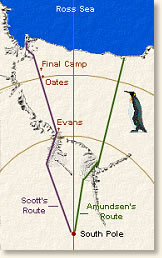
So, Edgar Evans was in fact the first person from Scott's crew to pass away on the expedition. He had cut his hand tending to a sleight and suffered from frostbite and exhaustion. Just before his death, he was described as turning mad - perhaps from the stress, illness or a fall. Here's an exerpt from Scott's diary:

"Saturday, February 17 - A very terrible day. Evans looked a little better after a good sleep, and declared, as he always did, that he was quite well. He started in his place on the traces, but half an hour later worked his ski shoes adrift, and had to leave the sledge. The surface was awful, the soft recently fallen snow clogging the ski and runners at every step, the sledge groaning, the sky overcast, and the land hazy. We stopped after about one hour, and Evans came up again, but very slowly.

Half an hour later he dropped out again on the same plea. He asked Bowers to lend him a piece of string. I cautioned him to come on as quickly as he could, and he answered cheerfully as I thought. We had to push on, and the remainder of us were forced to pull very hard, sweating heavily. Abreast the Monument Rock we stopped, and seeing Evans a long way astern, I camped for lunch. There was no alarm at first, and we prepared tea and our own meal, consuming the latter.

After lunch, and Evans still not appearing, we looked out, to see him still afar off. By this time we were alarmed, and all four started back on ski. I was first to reach the poor man and shocked at his appearance; he was on his knees with clothing disarranged, hands uncovered and frostbitten, and a wild look in his eyes. Asked what was the matter, he replied with a slow speech that he didn't know, but thought he must have fainted. We got him on his feet, but after two or three steps he sank down again. He showed every sign of complete collapse. Wilson, Bowers, and I went back for the sledge, whilst Oates remained with him.

When we returned he was practically unconscious, and when we got him into the tent quite comatose. He died quietly at 12.30 A.M. On discussing the symptoms we think he began to get weaker just before we reached the Pole, and that his downward path was accelerated first by the shock of his frostbitten fingers, and later by falls during rough travelling on the glacier, further by his loss of all confidence in himself. Wilson thinks it certain he must have injured his brain by a fall.

It is a terrible thing to lose a companion in this way, but calm reflection shows that there could not have been a better ending to the terrible anxieties of the past week. Discussion of the situation at lunch yesterday shows us what a desperate pass we were in with a sick man on our hands at such a distance from home."

Taken from: http://www.eyewitnesstohistory.com/scott.htm

The Terra Nova expedition had been gifted many things by wellwishers, including coal, cigars, plum puddings (?) and even a piano. In this piece I am describing a woman being shown around the ship before deperature (as they often were), and standing at the piano. I have used the piano as a metaphor for the declining mental state of Evans, who is with her at that time:


The Piano Man

“The wood will warp, sat out in the elements like this,” she thought, “the moist conditions will wreck it.” It’ll look the same, of course, on the outside but the workings will deform. The ice will work into its belly and fatten the dampeners, and the frost will make the strings creep.

The effect will be gradual of course, changing ever so slightly over time. Getting almost imperceptibly flatter and flatter until one day it’ll sound so horribly out of tune that you’ll wonder how you hadn’t picked up on it before. You don’t notice these things though, not until the string is stretched so tight that it’s likely to snap at any moment.

She felt sorry for this piano.

She took off a glove, ran her hand over the varnished mahogany, before lifting up the fall and pressing a key.

The note sounded out, as clear as a bell. A nearby pony looked up lazily from its hay, regarding her with its listless eyes before returning to his meal.

She looked up at him; a big oaf in a sailor outfit, smiling down at her.

“You like the piano, miss?” he said.

“Yes, very much so,” she answered, before gently shutting its lid.

                                                                    x