Professor Barnabus and Friends:
A blog of my writing, my dog, my musings, my travels, my photography
and anything else that takes my fancy...
Please feel free to comment
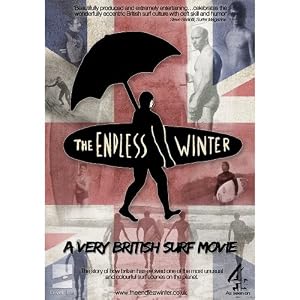
Top professional Cornish surfers Mark ‘Igor’ Harris and Mitch Corbett
are on a mission, a mission to discover the roots of surfing in the UK. Along
the way they meet the iconic locals who went on to become legends and get to
grips with what makes British surfing so special. The product of this journey
is ‘The Endless Winter’, and what a
journey it is.
“We wanted to make a film that British surfers could be proud of,” says
producer Matt Crocker who, along with James Dean, is responsible for the
movie.And that they have done. The film
is both interesting and informative, avoiding the Cornwall-heavy bias of many
British surf films by including many spots such as the Gower, Brighton and
Thurso East.
The film’s tagline is ‘A very British surf movie’, and it certainly goes
to fill a gap in a market oversaturated with footage of warm water barrels in
exotic locations. British surfing has evolved on its own terms and in its own
time and the resulting eccentric characters and hardcore surfing community is
covered well.
Igor and Mitch come across as genuinely nice guys and connect well with
those they are interviewing, such as surfing icons Pete ‘PJ’ Jones, Spencer Hargraves and Nigel Semmens. They reveal what UK
surfing was like at its birth, such as the ridiculousness of surfing in a
woolly jumper in January, whilst tackling more sensitive issues, such as the
suicide of promising young surfer Nigel Veitch who dived off the cliffs at
Tynemouth after losing his sponsor. The story is handled well and goes to show
that getting British surfers on the map, not to mention the rankings, was not
all plain sailing.
Memorable scenes include when Igor and Mitch
join ‘The Muddy Brothers’ by surfing the Severn Bore tidal wave in total
darkness, and the section on Sennen’s legendary Skewjack Surf Camp. The film
also reveals some surprising facts, such as surfing’s link to Agatha Christie,
King Edward 8th and Captain James Cook, as well as the effect of the
World Wars on the surfing community.
It’s had a positive reception, it won Best British Film at the 2012
London Surf/Film Festival and enjoyed outdoor premiers all over the UK.The soundtrack isn’t bad either; featuring
the obvious, but still good, Devonshire surfer Ben Howard as well as others,
such as The Fairport Convention and the imaginatively named Hotel Flamingo (I’d
never heard of them either). It also includes black and white film footage as
well as animations, courtesy of Simon Ball.
But there are problems. The in-water footage leaves a lot to desired,
it’s shaky and unsteady and a couple of times during the Badlands section it
even gets jammed into the sand, leaving viewers with an invigorating few
seconds of Cornish seaweed. The film could have also done with some more
footage of women surfers and groms, of which Britain has many, and excellent
ones at that.
However, my main bugbear is that the production team are not surfers.
Let me reiterate that, these guys don’t surf. In fact, in ‘The Making Of’
section, they admit that they found it hard when filming to anticipate the
surfers’ next move on the wave, their lack of knowledge being so. It seems
strange to have outsiders documenting and commenting on a community which is so
notoriously insular and close-knit. Those of us who were not lucky enough to
grow up surfing know how intimidating it can be at the beginning– the language,
rules, hierarchy, etiquette, not to mention the sometimes aggressive localism.
The well-worn idiom of ‘Only a surfer knows the feeling’ seems to be tested by
this DVD.
But they do make any effort to stick to just the main spots and don’t
reveal any that viewers wouldn’t know about already. I wonder how much of that
decision was based on the surfers’ code rather than the risk of getting their
windscreen waxed or face the backlash from revealing a secret spot. Plus, when
they approached and met the featured local surfers, who are legends in the
surfing world, I wonder if they had the same deep-set respect and admiration
that a surfer would have.
On the flip side, it means that even those who are not surfers can
understand, appreciate and be inspired by the film. And along with the 30
minutes of extras, the film is definitely worth a watch. It really does
encapsulate what makes British surfing unique, the history and evolution
surfing in the UK, and the fact that the never ending search for the perfect
wave has been with us from the very beginning.
Here's an article which I wrote for Uni about women in surfing. Enjoy:
Rise of the Beach Bunnies
“Surfing
and sex are inseparable,” says inertia.com surf editor Tetsuhiko Endo, but with
uneven contest prize money and sponsorship, do surfing and sexism come just as
intertwined.
Surfing has always been, and
probably always will be, a male dominated sport. Studies by the International
Surfing Association (ISA) estimate that worldwide there are between 17 to 23
million surfers, and out of those surfers, 15-20% are female. But according to
recent Global Industry Analyst reports, the worldwide surf market continues to
become more female and older, and considering that it is expected to reach $13.24 billion (£8.34 billion) by the year 2017, this is no
small movement. So, with these statistics in mind, why do the women’s tours
stand first to lose events due to lack of funds, why do women
surf the worst contest conditions and why do four of the world’s top seventeen women
surfers lack a major sponsor?
“The female side of the surf industry is about
selling clothes, that’s where the companies’ main income comes from,” says
Lucia Griggi, world-renowned surf photographer. And to sell the clothes, the
surfer needs to look good, hence the reason why many major sponsors are more
willing to give money to girls who fit the mould. “What that keeps reinforcing in women,” says
Queen of Teahupoo, Keala Kennelly to Endo on interia.com, “is that it is more
important to be beautiful, than it is to have talent or skill, or to be
accomplished.”
Keala surfing Jaws.
Women’s surfing does not
attract the sponsors or audience of men’s surfing, and even though the
Association of Surfing Professionals (ASP) set a rule that stating that any company who runs a
World Championship Tour (WCT) event must stage a women’s event as well, this
appears to be largely ignored. Louise Searle, editor of Surfgirl
magazine says that “the surf industry is in a bit of a mess at the moment [...]
which is why women who rip, like Paige [Hareb] are funding themselves. [The surf
companies] need to stay strong and remember their roots, the women’s tour
reflects this confusion and is leaving the girls frustrated, but the way
they’re marketed means [that] frock sales are more important than a thrilling
final in Hawaii.”
This would certainly explain
why surfers like Hareb have no World Tour sponsor, as the brands would prefer
to support younger, more commercial surfers such as Laura Enever or Sage
Erikson. Griggi, who travels on the tours with the professional surfers,
explains, “The companies don’t have [a large enough] budget to cover all girls,
[so] they choose the most marketable.” This means that there are two types of
riders on the tour, the few who are considered less attractive but have earned
a reputation as a good surfer, and the girls who are not as good at surfing,
but who look good in the clothes. Very few manage to straddle the line.
The girls are, of course,
aware of this and tailor themselves accordingly. Even Nike’s 2011 Leave a Message film, which by many was
viewed as a more credible girls surf movie showing “groundbreaking aerials and
long barrels”, still has a suspiciously large amount of footage of Monyca
Byrne-Wickey doing bottom turns in tinybikinis, not to mention Laura Enever surfing in a pair of fishnet
stockings. And this is by no means a recent occurrence, Wendy Botha, a four
times ASP world champion in the 1980s, posed naked for playboy. “It might be an indictment of surfing,” says the
surfline website, that Botha “is better known for her
spread in Playboy than for her incredible sporting achievements. That
fact says a lot about the pro surfing reportage of the past 20 years -- that
due to a male-dominated, and generally uninterested, surf media, some of
surfing's greatest champions have been ignored.”
Pro surfer Alana Blanchard
Professional female surfers
are aware that they are expected to walk the fine line between elite athlete
and poster girl. But they do so at the risk of sabotaging their credibility and
reputation, not to mention potentially compromising their surfing, as generally
a smaller physique means less power in turns. And the question needs to be
asked, are these surfers contributing to the objection by their compliance to
these ideals, forming a perpetual cycle of body image obsession. Unfortunately, according to the advertising,
it is not considered sexy to be athletic and strong.
The general, grass roots
image of surfing can be defined by mediums which are accessible to all. Of the
top 36 most viewed photos, tagged as ‘surf girl’ on magicseaweed.com, only eight
of those depict girls actually surfing. And one of those seems popular solely
for the fact that she is about to run over a pelican. And if you type the name
of Maya Gabeira, who is arguably the best all round, female, big wave rider in
the world, into a Google image search, there areno photos of her actually surfing until the
third page. Gabeira actually took a step further in the sex appeal stakes by
surfing naked for the ESPN Body Issue feature, which by its own admission
enables the readers to “gawk” at professional athletes, appearing alongside Steph Gilmore, Claire Bevilacqua, and
Men’s 11 times World Champion, Kelly Slater.
And the pros feel the
pressure, 2011 Red Bull Women’s World Champion Carissa Moore stated on her blog
that she often feels judged on her looks, stating that she has “trouble with
her weight” and can feel self-conscious performing “in front of thousands of
people in a bikini”. But as Searle remarked, “If I was Carissa, I would feel
self conscious too, but I can guarantee no one is watching her for looks, but
for her surfing skills.” However the question needs to be asked, why would one
of the sport’s top female competitors feel the need to conform to a physical
ideal. And could women conquer the balancing act of being feminine and
powerful, or in the eyes of the surfing community, are these mutually
exclusive.
But this is set to change as
more and more girls join the line up. “I see way more girls out there,” says
Jon, 37, a local Glamorgan coast surfer who has been surfing since childhood,
“it used to be a surprise to see a girl paddling out, but there’s definitely
more now. And they’re getting better and better.” A sentiment which seems to
divide local surfers, as Jamie, 39, says, “Having a girl in the line up changes
the mood, all the guys start to get all competitive and macho trying to impress
her. At the end of the day, I surf to get away from my missus.”
“I prefer to surf with
women,” says Porthcawl resident Jessica, 31, “the vibe is friendly and less
competitive. I feel that men judge the women first on their looks, and then
watch to see if we can actually stand up on a board.” Griggi illustrates, “Some
men have a little lack of respect [for women surfers], and will drop in on you
as they expect you not to make the wave [...], if you were a guy they would not
do this as much.” Many female surfers will be used to being judged when they
surf, especially in spots which are considered more challenging. The impromptu
audience feeling will probably be all too familiar, guys want to know if you
can handle yourself, and the best way to counteract this according to Griggi is
to “get a wave [and show] them you can surf, then they will leave you alone!”
However, regardless of the
stereotypes, the surf industry cannot help but take notice of the changing face
of women’s surfing. Surfing hardware is catching up to the standard of the
men’s as the demand for quality women’s wetsuit and wetsuit accessories
increases. Pro longboarder Kassia Meador has designed a fashion conscious
wetsuit range for Roxy, and the breadth of choice in women’s suits has
increased noticeably over the last few years. And the women themselves are
proving to the men that girls can surf just as hard as them, from Justine
Dupont’s October tow-in session at a
massive Aileen, during which she scored some of the biggest tubes ever ridden
by a woman in Europe, to Lakey Peterson’s technical air reverses.
And the effect is global, through
the Gaza Surf Retreat Project, girls are breaking down the gender barrier in
Palestine where the first female surf lifeguard has just been appointed, and in
Cuba, women bond through their love of surfing in a poverty stricken, isolated
country where trade embargoes mean that even the most basic surf equipment is
inaccessible.
Between us we are getting
bigger barrels, taking steeper drops, boosting higher airs and we are all
contributing to the changing the face of women’s surfing. “Most women and girls bring something more than beauty and a
sociological/psychological shift to the lineup,” says Surfermag’s Rob
Gilley, “they bring understanding. They bring grace.
They bring joy. To a pack of posturing men they bring the rarest commodity of
all: they bring smiles [...]. And if a girl happens to paddle out, I want you
to think long and hard before you snake the living daylights out of her.”
So, with girls charging
harder than ever before and pushing the boundaries further and further, women
all over the world are standing up to be counted, and it seems only a matter of
time before the phrase ‘You surf like a girl’ will be a compliment.